 Cliquez sur les vignettes
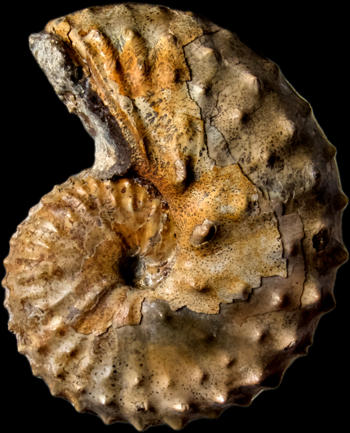
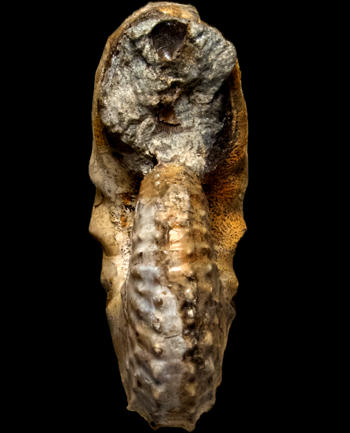
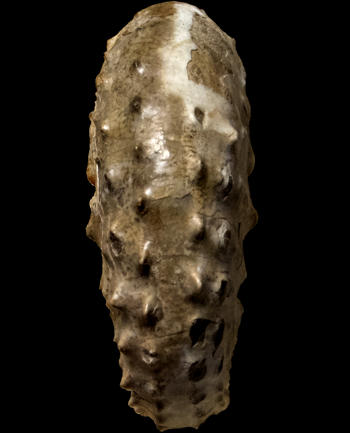
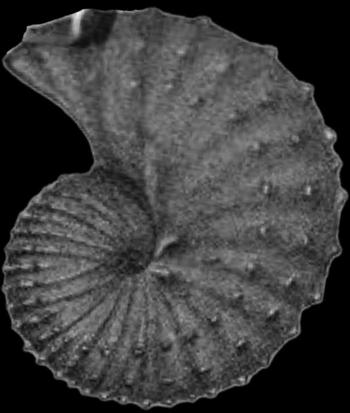
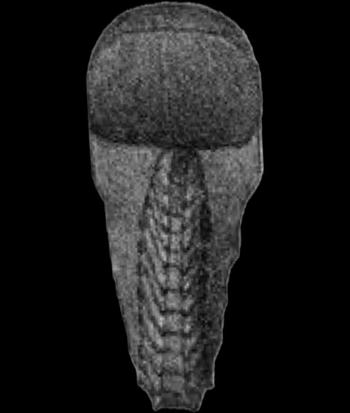
Discoscaphites gulosus (Morton 1834) (m) |
||
Étage
Maastrichtien (-72 à -65 millions d'années) supérieur
Localité
South Dakota - U.S.A.

Dimensions
Hauteur = 4,5 cm (1.77")
Commentaire
Ressources
Discoscaphites gulosus (MORTON 1834) sur le Cretaceous Atlas of Ancient Life Western Interior Seaway - lien
Classification
Genre :
Discoscaphites Meek 1871
Maastrichtien.
Scaphitinae multituberculé portant généralement quatre rangées de tubercules sur le flanc, presque régulièrement espacées, du rebord ombilical au rebord ventral. Le ventre est typiquement étroit. Les formes macroconques, robustes, sont 1,5 à 2 fois plus grandes que les microconques, plus graciles. La costulation est fine à grossière, mais peu distincte par rapport aux autres Scaphitinae. La loge d’habitation adulte est courte avec une crosse recourbée. [d’après Larson 2012]
Sous-famille :
Scaphitinae Gill 1871
Albien supérieur à Maastrichtien supérieur.
Groupe potentiellement polyphylétique constitué de deux lignées convergentes : l’une (Eoscaphites, Scaphites pars., Hoploscaphites, etc.) probablement issue des Worthoceras albiens, l’autre (Scaphites pars., Clioscaphites et un groupe de genres endémiques nord-américains) pouvant être issue de Yezoites infra-turoniens d’Amérique du Nord.
Microconques sans apophyses ou seulement dorsales. Rebord interne de la hampe généralement concave et fermant moins l’ombilic que chez le macroconque.
Famille :
Scaphitidae Gill 1871
Albien supérieur à Maastrichtien.
Scaphitoidea très dimorphiques, avec ou sans apophyses chez les microconques. Le bord interne de la hampe a tendance à masquer l’ombilic des macroconques.
Super-famille :
Scaphitoidea Meek 1876
Albien supérieur à Maastrichtien.
Formes enroulées en spirale lâche à serrée, suivie d’une hampe longue à courte et d’une crosse terminale qui peut envelopper la spire. L’ornementation est variable, de pratiquement absente jusqu’à présenter de fortes côtes et plusieurs rangées de tubercules. Les sutures quinquélobées chez les formes anciennes deviennent ensuite quadrilobées, mais présentent des "pseudolobes" chez les genres les plus récents, correspondant à des lobes auxiliaires au sein de la selle U/L. Le lobe latéral est bifide ou trifide.
Sous-ordre :
Turrilitina Beznosov & Mikhailova 1983
Ordre :
Ammonoidea Zittel 1884
Classe :
Cephalopoda Cuvier 1797
Embranchement :
Mollusca Linnaeus 1758
Super-embranchement :
Bilateria: Protostomia Hatschek, 1888: Grobben 1908
Sous-règne :
Eumetazoa Butschli 1910
Règne :
Animalia Linnaeus 1758
Super-règne :
Eukaryota Whittaker & Margulis 1978
Documents
[17]
2007. Landman, N., H., Johnson, R., O., Garb, M., P., Edwards, L., E. & Kyte, F., T.
Cephalopods from the Cretaceous/Tertiary Boundary Interval on the Atlantic Coastal Plain, with a Description of the Highest Ammonite Zones in North America. Part 3, Manasquan River Basin, Monmouth County, New Jersey
in Bulletin of the American Museum of Natural History - Nb 303 - American Museum of Natural History, New York
p 106, text-fig 51 (=Discoscaphites gulosus (MORTON, 1834)) - lien
2007. Lukedener, A.
Cephalopod evolution: A new perspective - Implications from two Early Cretaceous ammonoid suborders (Northern Calcareous Alps, Upper Austria)
in Denisia - Neue Serie 66, 20 - Oberösterreichischen Landesmuseen
fig 6C (=Discoscaphites gulosus (MORTON)) - lien
2007. Machalski, M., Jagt, J., W., M., Landman, N., H. & Motchurova-Dekova, N.
The highest records of North American scaphitid ammonites in the European Maastrichtian (Upper Cretaceous) and their stratigraphic implications
in Acta Geologica Polonica - Vol. 57 No. 2 - Université de Varsovie
p 176, fig 5.1-5.6 (=Discoscaphites gulosus (MORTON, 1834)) - lien
2004. Landman, N., H., Johnson, R., O. & Edwards, L., E.
Cephalopods from the Cretaceous/Tertiary Boundary Interval on the Atlantic Coastal Plain, with a Description of the Highest Ammonite Zones in North America. Part 1. Maryland and North Carolina
in American Museum Novitates - Nb 3454 - American Museum of Natural History
p 92, fig 39-Y, Z, a, b, 41E (=Discoscaphites gulosus (MORTON, 1934))
2004. Landman, N., H., Johnson, R., O. & Edwards, L., E.
Cephalopods from the Cretaceous/Tertiary Boundary Interval on the Atlantic Coastal Plain, with a Description of the Highest Ammonite Zones in North America. Part 2. Northeastern Monmouth County, New Jersey
in Bulletin of the American Museum of Natural History - Nb 287 - American Museum of Natural History, New York
p 37, fig 12C-J, 16 (=Discoscaphites gulosus (MORTON, 1834)) - lien
2003. Larson, N., L.
Predation and pathologies in the Late Cretaceous ammonite familty Scaphitidae
in M.A.P.S. Digest - Vol. 26, No. 3 - Mid-America Paleontology Society
fig 18, 23, 25 (=Discoscaphites gulosus) - lien
2001. Kennedy, W., J., Gale, A., S. & Hansen, T., A.
The last Maastrichtian ammonites from the Brazos River sections in Falls County, Texas
in Cretaceous Research - 22 - Academic Press Inc. (London) / Elsevier
cf. p 170, fig 4f (=Discoscaphites sp. cf. gulosus (MORTON, 1834)) - lien
2000. Kennedy, W., J., Landman, N., H., Cobban, W., A. & Johnson, R., O.
Additions to the Ammonite Fauna of the Upper Cretaceous Navesink Formation of New Jersey
in American Museum Novitates - Number 3306 - American Museum of Natural History
p 26, fig 9G-I (=Discoscaphites gulosus (MORTON, 1834))
1997. Kennedy, W., J., Cobban, W., A. & Landman, N., H.
Maastrichtian Ammonites from the Severn Formation of Maryland
in American Museum Novitates - Nb. 3210 - American Museum of Natural History
p 12, fig 20K-O, 21D, E (=Discoscaphites gulosus (MORTON, 1834))
1996. Landman, N., H., Tanabe, K. & Davis, R., A.
Ammonoid Paleobiology
in Topics in Geobiology - Vol. 13
photo de couverture et p vii (=Discoscaphites gulosus (MORTON, 1834))
1995. Cobban, W., A. & Kennedy, W., J.
Maastrichtian ammonites chiefly from the Prairie Bluff Chalk in Alabama and Mississippi
in Memoirs of the Palaeontological Society - 44 - The Palaeontological Society, Inc.
p 29, fig 10.4, 10.5, 19.20-19.24, 20.1, 20.2, 20.8-20.12, 20.14-20.17, 21.18-21.21 (=Discoscaphites gulosus (MORTON, 1834)) - lien
1994. Kennedy, W., J.
On the Identity of Two U.S. Western Interior Cretaceous Ammonites Described by Alcide d’Orbigny (1850)
in Journal of Paleontology - Vol. 68, No. 6 - Paleontological Society
p 1412 (=Ammonites danae d’ORBIGNY, 1850), fig 9-11 (=Discoscaphites gulosus (MORTON, 1834)) - lien
1993. Landman, N., H. & Waage, K., M.
Scaphitid Ammonites of the Upper Cretaceous (Maastrichtian) Fox Hills Formation in South Dakota and Wyoming
in Bulletin of the American Museum of Natural History - Number 215 - American Museum of Natural History, New York
p 212, fig 156, 157, 159, 160, 167-180 (=Discoscaphites gulosus (MORTON, 1834)) - lien
1982. Tzankov, V.
Les fossiles de Bulgarie - Va - Crétacé supérieur. Cephalopoda (Nautiloidea, Ammonoidea) et Echinodermata (Echinoidea)
Académie Bulgare des Sciences, Sofia
p 25, pl VII, fig 9, 10 (=Discoscaphites acutituberculatus sp. n.)
1978. Jeletzky, J., A. & Waage, K., M.
Revision of Ammonites conradi Morton 1834, and the Concept of Discoscaphites Meek 1870
in Journal of Paleontology - Vol. 52, No. 5 - Paleontological Society
p 1129, pl 2, fig 1-4, 8-10, 16-19, pl 3, fig 1-3 (=Discoscaphites conradi gulosus (MORTON), 1-4=holotype de Morton, 8-11=paratype macroconque) - lien
1876. Meek, F., B.
A Report on the Invertebrate Cretaceous and Tertiary Fossils of the Upper Missouri Country
in Hayden, F., V. - Report of the United States Geological Survey of the Territories - Volume IX - Department of the Interior. Washington: Government Printing Office
p 432, pl 36, fig 1 (=Scaphites conradi, var. gulosus, MORTON) - lien
1834. Morton, S., G.
Synopsis of the Organic Remains of the Cretaceous Group of the United States
Philadelphia, Key & Riddle
p 39, pl XVI, fig ii (=Ammonites conradi (S. G. M.) variety A. gulosus), pl XVI, fig i (=Ammonites conradi (S. G. M.) variety B. petechialis), p 40, pl XIX, fig iv (=Ammonites conradi (S. G. M.) variety C. navicularis)
Contenu révisé le 19 septembre 2026 - Fiche générée le 19 septembre 2026 - 1ère publication le 10 mars 2025
Espèce des zones à Nicolletii et Nebrascensis de la Mer Intérieure Américaine. Index de zone, avec Discoscaphites conradi MORTON, dans le Maastrichtien supérieur de la Gulf Coast (Larson 2016, p 23).
La forme macroconque est robuste avec une ornementation forte, faite généralement de cinq à six rangées de tubercules. La forme microconque a quatre a cinq rangées de tubercules. Chez les formes les plus récentes, chacun des dimorphes peut développer, ou pas, une rangée médio-ventrale sur la loge d’habitation adulte. [Landman & Waage 1993]