

 Cliquez sur les vignettes
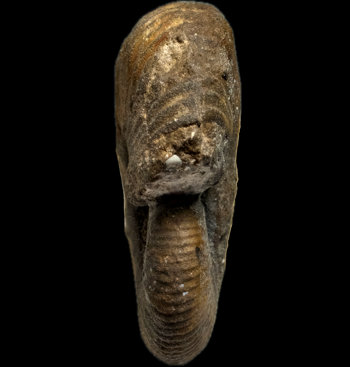
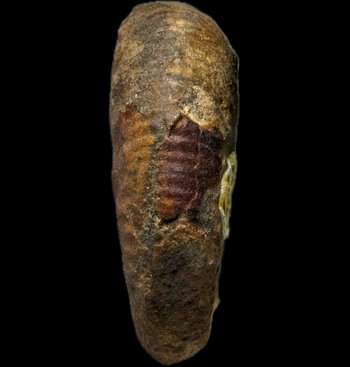
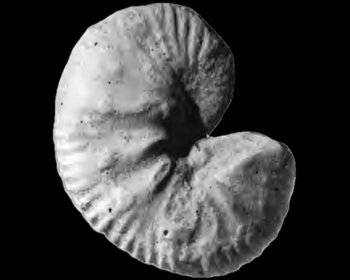
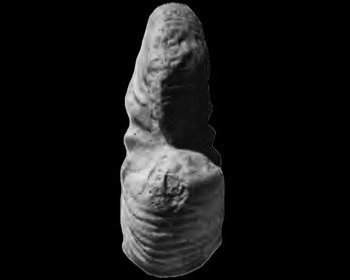
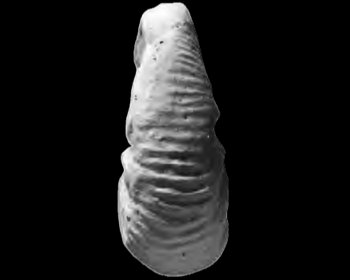
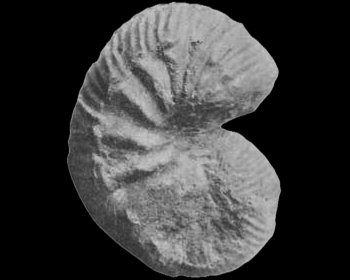
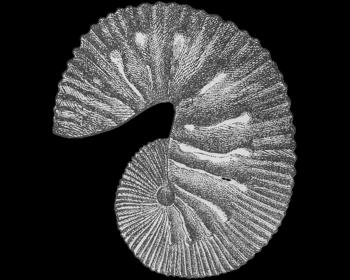
Scaphites kieslingswaldensis kieslingswaldensis Langenhan & Grundey 1891 (M) |
||
Étage
Coniacien (-88 à -87 millions d'années) moyen
Localité
Aude - France

Dimensions
Longueur = 3,5 cm (1.38")
Commentaire
Classification
Genre :
Scaphites Parkinson 1811
Albien supérieur à Campanien.
Formes comprimées à très renflées. Spire plus ou moins involute. Tours initiaux en contact. Hampe courte à moyenne. Crochet n’enveloppant pas la spire. Ouverture constrictée à colerette commune, portant une longue apophyse dorsale chez certaines espèces. Côtes de la spire alternant généralement longues et courtes, ou divisées. Côtes de la hampe simples ou divisées, généralement à partir d’un tubercule latéro-ventral. Tubercules ombilicaux et latéro-ventraux pouvant être présents sur la hampe et la crosse.
Sous-famille :
Scaphitinae Gill 1871
Albien supérieur à Maastrichtien supérieur.
Groupe potentiellement polyphylétique constitué de deux lignées convergentes : l’une (Eoscaphites, Scaphites pars., Hoploscaphites, etc.) probablement issue des Worthoceras albiens, l’autre (Scaphites pars., Clioscaphites et un groupe de genres endémiques nord-américains) pouvant être issue de Yezoites infra-turoniens d’Amérique du Nord.
Microconques sans apophyses ou seulement dorsales. Rebord interne de la hampe généralement concave et fermant moins l’ombilic que chez le macroconque.
Famille :
Scaphitidae Gill 1871
Albien supérieur à Maastrichtien.
Scaphitoidea très dimorphiques, avec ou sans apophyses chez les microconques. Le bord interne de la hampe a tendance à masquer l’ombilic des macroconques.
Super-famille :
Scaphitoidea Meek 1876
Albien supérieur à Maastrichtien.
Formes enroulées en spirale lâche à serrée, suivie d’une hampe longue à courte et d’une crosse terminale qui peut envelopper la spire. L’ornementation est variable, de pratiquement absente jusqu’à présenter de fortes côtes et plusieurs rangées de tubercules. Les sutures quinquélobées chez les formes anciennes deviennent ensuite quadrilobées, mais présentent des "pseudolobes" chez les genres les plus récents, correspondant à des lobes auxiliaires au sein de la selle U/L. Le lobe latéral est bifide ou trifide.
Sous-ordre :
Turrilitina Beznosov & Mikhailova 1983
Ordre :
Ammonoidea Zittel 1884
Classe :
Cephalopoda Cuvier 1797
Embranchement :
Mollusca Linnaeus 1758
Super-embranchement :
Bilateria: Protostomia Hatschek, 1888: Grobben 1908
Sous-règne :
Eumetazoa Butschli 1910
Règne :
Animalia Linnaeus 1758
Super-règne :
Eukaryota Whittaker & Margulis 1978
Documents
[24]
2024. Kennedy, W., J. & Summesberger, H.
On some Turonian and Coniacian ammonites from the Czech Republic
in Acta Geologica Polonica - Vol. 74, No 2 - Université de Varsovie
p 27, pl 12, fig 3, 4, 7-9, 11-13, pl 13, fig 1-9, 11, 15-17, 20-21 (=Scaphites kieslingswaldensis LANGENHAN & GRUNDEY, 1891) - lien
2023. Kennedy, W., J. & Walaszcyk, I., P.
The Upper Turonian-Lower Coniacian (Upper Cretaceous) ammonites from the condensed phosphate beds of Mangyshlak, NW Kazakhstan
in Acta Geologica Polonica - Vol. 73 No. 4: Proceedings of the 11th International Cretaceous Symposium - Université de Varsovie
p 653, text-fig 11C, 14A-S, 15A-F (=Scaphites kieslingswaldensis LANGENHAN & GRUNDEY, 1891) - lien
2013. Kennedy, W., J. & Klinger, H., C.
Scaphitid ammonites from the Upper Cretaceous of KwaZulu-Natal and Eastern Cape Province, South Africa
in Acta Geologica Polonica - Vol. 63, No. 4 - Université de Varsovie
pl 1, fig 1-29, pl 2, fig 1-9, 14-17, pl 3, fig 1-17, text-fig 6C - lien
2012. Diebold, F.
Systematics, biostratigraphy and biogeography of the ammonoid family Collignoniceratidae across the Turonian-Coniacian (Cretaceous) boundary in the West European and Indo-Malgach provinces
University of Heidelberg - PhD Thesis
chap 2, p 156, pl 11, fig 1 (=Scaphites kieslingswaldensis LANGENHAN & GRUNDEY, 1891)
2011. Schneider, S., Niebuhr, B., Wilmsen, M. & Vodrážka, R.
Between the Alb and the Alps - The fauna of the Upper Cretaceous Sandbach Formation (Passau region, southeast Germany)
in Bulletin of Geosciences - 86 (4) - Czech Geological Survey, Prague
?p 810, fig 12G (=Scaphites kieslingswaldensis doylei? WRIGHT, 1979) - lien
2009. Wilmsen, M., Wood, C., J., Niebuhr, B. & Kaplan, U.
Cenomanian-Coniacian ammonoids of the Danubian Cretaceous Group (Bavaria, southern Germany)
in Niebuhr, B. - Litho- und Biostratigraphie der außeralpinen Kreide von Bayern - p 111-124
?p 121, fig 10G (=Scaphites kieslingswaldensis doylei? WRIGHT)
2000. Wiese, F.
Coniacian (Upper Cretaceous) ammonites from the North Cantabrian Basin (Cantabria, northern Spain)
in Acta Geologica Polonica - Vol. 50 No. 1: Henryk Makowski Memorial Volume - Université de Varsovie
cf. p 136, pl 1, fig 5 (=Scaphites cf. kieslingswaldensis LANGEHAN & GRUNDEY, 1891) - lien
1996. Tarkowski, R.
Inoceramids biostratigraphy in the Turonian of Opole Trouhg (south-western Poland)
in Mitteilungen aus dem Geologisch-Paläontologischen Institut der Universität Hamburg - Heft 77 - Universität Hamburg
pl 3, fig 16 (=Scaphites kieslingswaldensis doylei WRIGHT) - lien
1995. Kennedy, W., J., Bilotte, M. & Melchior, P.
Ammonite faunas, biostratigraphy and sequence stratigraphy of the Coniacian-Santonian of the Corbières
in Bulletin des Centres de Recherche Exploration-Production ELF-Aquitaine - Vol. 19, No 2 - ELF Exploration-Production
p 432, pl 30 - lien
1994. Kaplan, U. & Kennedy, W., J.
Ammoniten des westfälischen Coniac
in Geologie und Paläontologie in Westfalen - Heft 31 - Westfalisches Museum fur Naturkunde
p 60, tag 40, fig 9-14, taf 41, fig 1-13 (=Scaphites (Scaphites) kieslingswaldensis kieslingswaldensis LANGENHAN & GRUNDEY, 1891) - lien
1988. Thomel, G.
Les ammonites néocrétacées (Coniacien-Santonien-Campanien) des chaînes subalpines méridionales (Alpes-Maritimes et Alpes de Haute-Provence)
in Mémoires de la Société Géologique de France - Nouvelle Série - No 153 - Société Géologique de France
p 27, text-fig 16 (=Scaphites meslei de GROSSOUVRE) - lien
1987. Kaplan, U., Kennedy, W., J. & Wright, C., W.
Turonian and Coniacian Scaphitidae from England and North-Western Germany
in Geologisches Jahrbuch - A 103 - Hannover
p 13, pl 3, fig 6-8 (=Scaphites kieslingswaldensis doylei WRIGHT, 1979), p 14, pl 4, fig 3-6, pl 5, fig 1-5 (=Scaphites kieslingswaldensis kieslingswaldensis LANGENHAN & GRUNDEY, 1891, pl 5, fig 5=moulage de l’holotype)
1984. Kennedy, W., J.
Systematic palaeontology and stratigraphic distribution of the Ammonite faunas of the french Coniacian
in Special Papers in Palaeontology - Nb 31 - The Palaeontological Association
pars. p 138, pl 31, fig 1-13, 15-19 (=Scaphites (Scaphites) meslei de GROSSOUVRE), non fig 14 (=Yezoites orbignyi KENNEDY & al., 1995) - lien
1979. Wright, C., W.
The ammonites of the English Chalk Rock (Upper Turonian)
in Bulletin Natural History Museum London (Geol.) - Vol. 31, No. 4 - The Natural History Museum
p 304, pl 3, fig 13 (=Scaphites lamberti doylei subsp. nov.), non p 303, pl 3, fig 10-12 (non Scaphites kieslingswaldensis LANGENHAN & GRUNDEY ; =Scaphites geinitzii d’ORBIGNY 1850) - lien
1965. Collignon, M.
Atlas des fossiles caractéristiques de Madagascar (Ammonites) - Fascicule XIII (Coniacien)
Service Géologique Tananarive - Ministère de l’Industrie et des Mines - République Malgache
p 16, pl CDXX (=Scaphites meslei var. masiaposensis nov. var.), p 17, pl CDXX (=Scaphites arnaudiformis nov. sp.)
1901. Sturm, F.
Der Sandstein von Kieslingswalde in der Grafschaft Glatz und seine Fauna
in Jahrbuch der Königlich preussischen geologischen Landesanstalt zu Berlin - 21 - Berlin Simon Schropp’schen Hof-Landkartenhandlung 1881-1908
taf III, fig 8 (=Scaphites kieslingswaldensis LANGEHAN & GRUNDEY) - lien
1898. Leonhard, R.
Die Fauna der Kreideformation in Oberschlesien
in Palaeontographica - 44 - E. Schweizerbart’sche Verlagsbuchhandlung, Stuttgart
p 61, taf VI, fig 7, 8 (non Scaphites lamberti GROSSOUVRE ; =Scaphites silesiaca FRECH 1915) - lien
1895-1903. Fritsch, A.
Studie en im Gebiete der Böhmischen Kreideformation. Palaeontoloqische Untersuchungen der einzelnen Schichten. Die Chlomecker Schichten.
in Archiv f. naturwissenschaftliche Landesdurchforschung von Böhmen - 10
p 37, fig 20 (non Scaphites binodosus RÖM. ; holotype de Scaphites kieslingwaldensis) - lien
1895. Jahn, J., J.
Einige Beiträge zur Kenntniss der böhmischen Kreideformation
in Jahrbuch der Geologischen Bundesanstalt - 45
taf VIII, fig 1 (=Scaphites cf. geinitzi var. lamberti GROSSOUVRE ; =sous-espèce doylei), fig 2 (=Uebergangsform zwischen Scaphites cf. leinitzi var. lamberti GROSSOUVRE und Scaphites geinitzi d’ORB. ; =sous-espèce kieslingswaldensis) - lien
1894. Grossouvre (de), A.
Recherches sur la Craie Supérieure
Imprimerie Nationale
p 239, pl XXXII (=Scaphites meslei, nov. sp.), p 241, pl 32 (=Scaphites lamberti, nov. sp.), p 242, pl XXII (=Scaphites potieri, nov. sp.) - lien
1891. Langenhan, A. & Grundey, M.
Das Kieslingswalder Gestein und seine Versteinerungen
in Jahresbericht nebst Mitglieder-Verzeichnis des Glatzer Gebirgs-Vereins - 10
p 9, pl II, fig 1 (=Scaphites kieslingswaldensis n. sp.) - lien
1873. Redtenbacher, A.
Die Cephalopodenfauna der Gosauschichten in den nordöstlichen Alpen
in Abhandlungen der Geologischen Bundesanstalt - Band V, heft 5 - Geologische Bundesanstalt in Wien
p 130[40], pl XXX, fig 12 (non Scaphites spec. indet. cfr. Scaphites constrictus SOWERBY) - lien
1872. Fritsch, A.
Cephalopoden der böhmischen Kreideformation
Fr. Rivnac, Prague
?p 43, pl 14, fig 13 (non Scaphites geinitzii d’ORB. var. binodosus, RÖM.) - lien
1871-1872. Schlüter, C.
Cephalopoden der oberen deutschen Kreide - 1
in Palaeontographica - 21 - E. Schweizerbart’sche Verlagsbuchhandlung, Stuttgart
pars. p 75, taf XXIII, fig 12-16, 23-25 (non Scaphites geinitzii, d’ORBIGNY), taf XXVII, fig 9 (non Scaphites cf. geinitzii, d’ORBIGNY) - lien
Contenu révisé le 19 septembre 2026 - Fiche générée le 19 septembre 2026 - 1ère publication le 26 avril 2003
Scaphites kieslingwaldensis s. l. s’étend stratigraphiquement du Turonien supérieur au Santonien inférieur et géographiquement en Angleterre, France, Allemagne, République tchèque, Autriche, Pologne, Espagne et Madagascar.
Espèce de taille petite à modérée à côtes primaires grossières et espacées, divisées en deux ou trois secondaires assez haut sur le flanc. Sur la hampe, les primaires fortes et plus ou moins radiales et naissent simples ou par paire à partir de tubercules ombilicaux. [Kaplan & al. 1987]
Elle est bituberculée, portant des tubercules ombilicaux sur la hampe et des tubercules latéro-ventraux à la fois sur la hampe et le tour externe de la spire. Les tubercules sont plus forts chez les microconques que chez les macroconques. [Kaplan & al. 1987]