
 Cliquez sur les vignettes
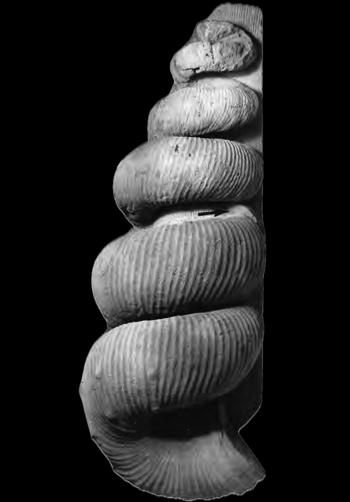
Bostrychoceras polyplocum (Roemer 1841) |
||
Étage
Campanien (-83 à -72 millions d'années) supérieur
Localité
Landes - France

Dimensions
Hauteur visible = 7 cm (2.76")
Commentaire
Classification
Genre :
Bostrychoceras Hyatt 1900
Campanien.
Tours d’abord enroulés en hélice lâche, suivis d’une hélice plus serrée et, enfin, une loge d’habitation adulte en U, détachée, avec l’ouverture dirigée vers le haut. Les côtes se rejoignent et bouclent entre deux rangées de tubercules. Sur les tours jeunes, des côtes non tuberculées s’intercalent entre ces motifs. Les tubercules peuvent disparaître sur le stade hélicoïdal serré, avant de réapparaître sur le loge d’habitation adulte. Des constrictions peuvent exister, notamment en association avec le péristome adlute. [Kennedy 2020]
Famille :
Nostoceratidae Hyatt 1894
Turonien à Maastrichtien.
Ammonites hétéromorphes à enroulement hélicoïdal, mais dont l’hélice est irrégulière, se terminant parfois en crochet ou en une seconde spire plane. Les côtes sont fortes et parfois tuberculées. Les constrictions apparaissent communément.
Super-famille :
Turrilitoidea Meek 1876
?Aptien supérieur à Maastrichtien supérieur.
Ensemble de familles, directement ou indirectement dérivées des Anisoceratidae ou Hamitidae, incluant pratiquement toutes les morphologies connues chez les hétéromorphes. Comprend des genres costulés, tuberculés et lisses. Les sutures quadrilobées contrastent avec les sutures quinquélobées des Ancyloceratoidea. Elles ont généralement des lobes latéraux bifides, mais ils peuvent être trifides chez les genres les plus anciens. La séparation avec les Ancyloceratoidea du Crétacé inférieur est justifiée par une radiation évolutive ayant stabilisé ces nouvelles caractéristiques suturales.
Sous-ordre :
Turrilitina Beznosov & Mikhailova 1983
Ordre :
Ammonoidea Zittel 1884
Classe :
Cephalopoda Cuvier 1797
Embranchement :
Mollusca Linnaeus 1758
Super-embranchement :
Bilateria: Protostomia Hatschek, 1888: Grobben 1908
Sous-règne :
Eumetazoa Butschli 1910
Règne :
Animalia Linnaeus 1758
Super-règne :
Eukaryota Whittaker & Margulis 1978
Documents
[34]
2021. Schaffert, A. & Larson, N.
The Heteromorph Ammonite Family Nostoceratidae - A Number of Observations and A Systematic Review
The Tethys Ocean Project, Inc.
pars. p 49, fig 26, 89-91, 95 (=Bostrychoceras polyplocum (ROEMER, 1841)), non fig 92 (=Euskadiceras euskadiense KÜCHLER 2000), non fig 93, 94 (=Euskadiceras unituberculatum (BLASZKIEWICZ 1980)) - lien
2020. Kennedy, W., J.
The Ammonoidea of the Upper Chalk. Part 2
in Monograph of the Palaeontographical Society - 174:656, 106-290 - The Palaeontographical Society - London
pars. p 135, pl 42, fig 1, 2, 7-12, pl 43, fig 1-5, pl 44, fig 5-9, text-fig 72-74, 76B, D, E (=Bostrychoceras polyplocum (ROEMER, 1841)) - lien
2015. Ifrim, C., Stinnesbeck, W., Espinosa, B. & Flores Ventura, J.
Upper Campanian (Upper Cretaceous) cephalopods from the Parras Shale near Saucedas, Coahuila, Mexico
in Journal of South American Earth Sciences - Volume 64, Part 1 - Elsevier
p 243, fig 5J, K, 13A-I, 14A-K (=Bostrychoceras polyplocum (ROEMER, 1841)) - lien
2007. Kennedy, W., J., Tunoglu, C., Walaszczyk, I. & Ertekin, I., K.
Ammonite and inoceramid bivalve faunas from the Davutlavur Formation of the Devrekani-Kastamonu area, northern Turkey, and their biostratigraphic significance
in Cretaceous Research - 28 - Academic Press Inc. (London) / Elsevier
p 871, fig 3C, 6A, B, 7A-C, G, 9I, J (=Bostrychoceras polyplocum (ROEMER, 1841)) - lien
2007. Lebrun, P.
Ammonites du Crétacé - Tome II : Ancyloceratina
in Minéraux & Fossiles - Hors-Série No 22 - CEDIM
p 205, fig 6.138 (=Nostoceras (Bostrychoceras) polyplocum)
2005. Kaplan, U., Kennedy, W., J. & Hiß, M.
Stratigraphie und Ammonitenfaunen des Campan im nordwestlichen und zentralen Münsterland
in Geologie und Paläontologie in Westfalen - 64 - Westfalisches Museum fur Naturkunde
p 106, taf 42, fig 1, 2, taf 43, fig 1-3, taf 44, fig 1, 2, taf 45, fig 2, taf 48, fig 5 (=Bostrychoceras polyplocum (ROEMER, 1841)) - lien
2004. Niebuhr, B.
Late Campanian nostoceratid ammonites from the Lehrte West Syncline near Hannover, northern Germany
in Acta Geologica Polonica - Vol. 54, No 4 - Université de Varsovie
p 478, pl 2, fig , text-fig 3, 5f (=Nostoceras (Bostrychoceras) polyplocum (ROEMER, 1841)) - lien
2002. Monks, N. & Palmer, P.
Ammonites - The Living Past Series
Smithsonian Institution Press, Washington, D.C. & The Natural History Museum, London
p 75, pl 16 (=Bostrychoceras polyplocuin (sic, typo))
2002. Wright, C., W. & Kennedy, W., J.
Ammonites
in Smith, A., B. & Batten, D., J. - Fossils of the Chalk - Second Edition - Chapter 9 - The Palaeontological Association
p 211, pl 40, fig 6 (=Nostoceras (Bostrychoceras) polyplocum (ROEMER))
2001. Küchler, T., Kurtz, A. & Wagreich, M.
The Campanian-Maastrichtian boundary in northern Spain (Navarra province) : the Imiscoz and Erro sections
in Odin, G., S. - The Campanian-Maastrichtian Stage Boundary - Characterisation at Tercis les Bains (France) and Correlation with Europe and other Continents. Developments in Palaeontology and Stratigraphy, 19 - Ch. E3 - Elsevier
p 735, pl I, fig 1 (=Nostoceras (Bostrychoceras) polyplocum schlueteri (BLASZKIEWICZ, 1980)) - lien
2001. Küchler, T. & Odin, G., S.
Upper Campanian-Maastrichtian ammonites (Nostoceratidae, Diplomoceratidae) from Tercis les Bains (Landes, France)
in Odin, G., S. - The Campanian-Maastrichtian Stage Boundary - Characterisation at Tercis les Bains (France) and Correlation with Europe and other Continents. Developments in Palaeontology and Stratigraphy, 19 - Ch. D4e - Elsevier
p 502, pl I, fig 3-6, 5-7, text-fig 3 (=Nostoceras (Bostrychoceras) polyplocum polyplocum (ROEMER)), p 503 (=Bostrychoceras polyplocum schlueteri (BLASZKIEWICZ, 1980)) - lien
2001. Kennedy, W., J. & Cobban, W., A.
Campanian (Late Cretaceous) Ammonites from the upper part of the Anacacho Limestone in South- Central Texas
in Acta Geologica Polonica - Vol. 50 No. 1: Henryk Makowski Memorial Volume - Université de Varsovie
p 22, pl 4, fig 6, pl 5, fig 1-3, 5-7, text-fig 5 (=Bostrychoceras polyplocum (ROEMER, 1841)) - lien
2000. Arkadiev, V., V., Atabekian, A., A., Baraboshkin, E., Y. & Bogdanova, T., N.
Stratigraphy and ammonites of Cretaceous deposits of South-West Crimea
in Palaeontographica Abteilung A - 255 (4-6) - E. Schweizerbart’sche Verlagsbuchhandlung, Stuttgart
p 117, pl 12, fig 3-5 (=Bostrychoceras polyplocum (ROEMER, 1841)) - lien
2000. Küchler, T.
Upper Cretaceous of the Barranca (Navarra, northern Spain); integrated litho-, bio- and event stratigraphy. Part II: Campanian and Maastrichtian
in Acta Geologica Polonica - Vol. 50, No 4 - Université de Varsovie
pl 13, fig 1, pl 14, fig 1, 3, 5, 6, 7 (=Nostoceras (Bostrychoceras) polyplocum polyplocum (ROEMER)), pl 16, fig 4, 5 (=Nnostoceras (Didymoceras) depressum (WIEDMANN)) - lien
2000. Robaszynski, F., González Donoso, J., M., Linares, D., Amédro, F., Caron, M., Dupuis, C., Dhondt, A., V. & Gartner, S.
Le Crétacé supérieur de la région de Kalaat Senan, Tunisie centrale, lith-biostratigraphie intégrée, zones d’ammonites, de foraminifères planctoniques et de nannofossiles du Turonien supérieur au Maastrichtien
in Bulletin des Centres de Recherche Exploration-Production ELF-Aquitaine - 22(2) - ELF Exploration-Production
p 405, pl 6, fig 5, pl 7, fig 1, 6, 8, pl 8, fig 2 (=Nostoceras (Bostrychoceras) polyplocum (ROEMER, 1841))
1999. Kennedy, W., J. & Summesberger, H.
New Late Campanian ammonites from the Gschliefgraben near Gmunden (Ultrahelvetic; Austria)
in Beiträge zur Paläontologie - 24 - Verein zur Förderung der Paläontologie, Wien
non p 26, pl 2, fig 4, 5 (=Euskadiceras unituberculatum (BLASZKIEWICZ 1980)) - lien
1997. Kennedy, W., J. & Christensen, W., K.
Santonian to Maastrichtian ammonites from Scania, southern Sweden
in Fossils and Strata - Vol. 44 - Scandinavian University Press
p 104, text-fig 20 (=Bostrychoceras polyplocum (ROEMER, 1841)) - lien
1997. Kennedy, W., J. & Kaplan, U.
Ammoniten aus dem Campan des Stemweder Berges, Dammer Oberkreidemulde, NW-Deutschland
in Geologie und Paläontologie in Westfalen - Heft 50 - Westfalisches Museum fur Naturkunde
pars. p 52, taf 39, figs 1, 4, taf 40, fig 6, 8, 9, 11, taf 41, fig 1, 7, 9, taf 42, fig 5, 5, 6, taf 43, fig 1, 2, 4, 5, taf 44, fig 1, 2, taf 45, fig 1-4, taf 46, fig 1, 2, taf 47, figs 1-3, 7, 8, taf 48-50 (=Bostrychoceras polyplocum (ROEMER, 1841), taf 39, fig 1=lectotype, taf 39, fig 4=néotype), non taf 47, fig 4-6 (=Didymoceras varium (BLASZKIEWICZ, 1980)), non taf 51, fig 1, 2 (=Euskadiceras euskadiense II KÜCHLER 2000), non taf 39, fig 2, 3, non taf 40, fig 1-5, 7, 10, non taf 41, fig 2-6, 8, non taf 42, fig 1, 2, 4, 7, non taf 43, fig 3 (=Didymoceras densecostatum (WIEDMANN 1962)) - lien
1996. Santamaria, R. & López, G.
Aspectos bioestratigráficos de los ammonites e inocerámidos (Bivalvia) del Albiense Superior al Maastrichtiense de la provincia de Alava
in Revista Española de Paleontologia - 11 (3) - Sociedad Española de Paleontología
pl I, fig 3 (=Nostoceras (Bostrychoceras) polyplocum (ROEMER)) - lien
1996. Wright, C., W., Callomon, J., H. & Howarth, M., K.
Treatise on Invertebrate Paleontology - Part L : Mollusca 4 Revised - Volume 4 : Cretaceous Ammonoidea
Roger L. Kaesler - Geological Society of America
p 245, fig 191.1 (=Nostoceras (Bostrychoceras) polyplocum (ROEMER)) - lien
1986. Kennedy, W., J.
Campanian and Maastrichtian ammonites from northern Aquitaine, France
in Special Papers in Palaeontology - Nb 36 - The Palaeontological Association
pars. p 92, pl 6, fig 1, pl 15, fig 1-3, 5, 7, 8, text-fig 32A, B, 33A, B, 34A, D-F, 35A, B, D, 36 (=Nostoceras (Bostrychoceras) polyplocum (ROEMER, 1841)), non pl 15, fig 6 (=Euskadiceras unituberculatum (BLASZKIEWICZ 1980)), non text-fig 34G, H (=Didymoceras varium (BLASZKIEWICZ, 1980), non text-fig 33C-E, non text-fig 34B, C, non text-fig 35C (=Didymoceras densecostatum (WIEDMANN 1962)) - lien
1985. Bilotte, M.
Le Crétacé supérieur des plates-formes est-pyrénéennes
in Actes du Laboratoire de Géologie Sédimentaire et Paléontologie - Série 2 : mémoires, Vol. 1 (planches, 1984), Vol. 5 (texte, 1985) - Université Paul-Sabatier, Toulouse
pl 37, fig 4 (=Bostrychoceras polyplocum ROEMER)
1984. Kennedy, W., J.
Ammonite faunas of the Coniacian, Santonian and Campanian stages in the Aquitaine Basin
in Géologie Méditerranéenne - Tome X, no 3-4 - Centre d’Etudes Méditerranéennes
pl 3, fig 11 (=Nostoceras (Bostrychoceras) polyplocum (ROEMER, 1841)), non fig 8 (=Euskadiceras euskadiense KÜCHLER 2000)
1984. Kennedy, W., J. & Summesberger, H.
Upper Campanian Ammonites from the Gschliefgraben (Ultrahelvetic, Upper Austria)
in Beiträge zur Paläontologie Österreichs - 11 - Universität Wien. Paläontologisches und Geoogisches Institutes
?pars. p 164, pl 9, fig 4, 8, 12, 14 (=Nostoceras (Bostrychoceras) polyplocum (ROEMER, 1841)), ?non fig 13 (?=Euskadiceras unituberculatum (BLASZKIEWICZ 1980)) - lien
1982. Tzankov, V.
Les fossiles de Bulgarie - Va - Crétacé supérieur. Cephalopoda (Nautiloidea, Ammonoidea) et Echinodermata (Echinoidea)
Académie Bulgare des Sciences, Sofia
p 18, pl 3, fig fig 5 (=Bostrychoceras polyplocum (ROEMER, 1841))
1980. Błaszkiewicz, A.
Campanian and Maastrichtian ammonites of the Middle Vistula River Valley, Poland: a stratigraphic-paleontological study
in Prace Instytutu Geologicznego - XCII
p 20, pl I, fig 1-9, pl XI, fig 2, 3, 5, 6 (=Nostoceras (Bostrychoceras) polyplocum polyplocum (ROEMER, 1841)), p 20, pl II, fig 1, 4, 9-11 (=Bostrychoceras polyplocum schlueteri subsp. nov.), p 24, pl V, fig 4, 6, pl VII, fig 16, 19 (=Didymoceras cf. secoense (YOUNG, 1963)), p 25, pl VIII, fig 1-6, ?pl IX, fig 1-6 (=Didymoceras postremum sp. nov.)
1976. Atabékian, A., A. & Khakimov, F., K.
Ammonites campaniennes et maastrichtiennes d’Asie centrale [en Russe]
Académie des sciences de la R.S.S. du Tadjikistan - Institut de Géologie - Donisch, Douchanbé
p 54, pl VI, fig 1-4, pl VII, fig 1, 2 (=Bostrychoceras polyplocum (ROEMER)) - lien
1975. Schmid, F. & Ernst, G.
Ammoniten aus dem Campan der Lehrter Westmulde und ihre stratigraphische Bedeutung. 1. Teil: Scaphites, Bostrychoceras und Hoplitoplacenticeras
in Berichte der Naturhistorischen Gesellschaft Hannover - 119 - Naturhistorischen Gesellschaft Hannover
p 339, taf 4, fig 2, 3 (=Bostrychoceras (Bostrychoceras) polyplocum (F.A. ROEMER, 1841)) - lien
1974. Krymholz, G., J. (coord.), Blank, M., J., Naïdin, D., P. & Savchinskaïa, O., V.
Atlas des faunes du Crétacé supérieur du Donbass [en Russe]
NEDRA
p 165, pl 54, fig 1-3, pl 55, fig 1 (=Bostrychoceras polyplocum (ROEMER, 1841))
1962. Wiedmann, J.
Ammoniten aus der Vascogotischen Kreide (Nordspanien) I. Phylloceratina, Lytoceratina
in Palaeontographica Abteilung A - 118 - E. Schweizerbart’sche Verlagsbuchhandlung, Stuttgart
p 198 (=Cirroceras (Cirroceras) polyplocum (A. ROEMER)), p 199 (=Cirroceras depressum n. sp.), p 200, taf 11, fig 4 (=Cirroceras (Cirroceras) polyplocum polyplocum (A. ROEMER)), non pars. p 200 (non Cirroceras (Cirroceras) indicum (STOL.)), non p 200, taf 9, fig 5 (non Cirroceras (Cirroceras) polyplocum zumayense n. ssp. ; =Nostoceras hyatti STEPHENSON 1941)
1871-1872. Schlüter, C.
Cephalopoden der oberen deutschen Kreide - 1
in Palaeontographica - 21 - E. Schweizerbart’sche Verlagsbuchhandlung, Stuttgart
pars. p 112, taf 33, fig 3-5, 7, 8, taf 34, fig 1-5, taf 35, fig 5, 8 (=Heteroceras polyplocum, A. RÖM. sp.), non taf 33, fig 6, non taf 35, fig 1-4, 5-7 (=Didymoceras densecostatum (WIEDMANN 1962)) - lien
1845-1846. Geinitz, H., B.
Grundriss der Versteinerungskunde
Dresden ; Leipzig, Arnoldischen Buchhandlung
non p 305, taf XII, fig 5 (non Turrilites polyplocus RÖM. ; =Eubostrychoceras saxonicum (SCHLÜTER 1876)) - lien
1840-1841. Roemer, F., A.
Die Versteinerungen des nord-deutschen Kreidegebirges
Hannover, Hahn
pars. p 92, pl XIV, fig 1 (=Turrilites polyplocus N.), non fig 2 (=Eubostrychoceras saxonicum (SCHLÜTER 1876)) - lien
1839-1842. Geinitz, H., B.
Charakteristik der Schichten und Petrefacten des sächsischen Kreidegebirges
Dresden und Leipzig, In der Arnoldischen buchhandlung
non p 67, taf XIII, fig 1 (non Turrilites polyplocus RÖM. ; =Eubostrychoceras saxonicum (SCHLÜTER 1876)) - lien
Contenu révisé le 19 septembre 2026 - Fiche générée le 19 septembre 2026 - 1ère publication le 4 juin 2000
Espèce du Campanien supérieur, index de zone en Europe du nord-ouest.
Diagnose proche de celle du genre. L’hélice est dextre ou sénestre, les tours arrondis, non adjacents, jusqu’à un diamètre de 20-25 mm. Angle apical très variable. Il y a 80 à 90 côtes fines par tour et deux à trois constrictions. La plupart des côtes sont atuberculées et alternent avec des côtes tuberculées. Les formes attribuées au genre Euskadiceras Küchler 2000, diffèrent par la présence de tubercules tout au long de l’ontogènèse et un stade adulte détaché en forme de virgule, avec l’ouverture pointant vers le bas. [Schlater & Larson 2021, Kennedy 2020]